Wednesday, March 23, 2011

Happy Mardi Gras

Grant's school celebrated international day on the Friday before Mardi Gras.  People were supposed to bring food native to their country, so he and I baked a King Cake.  Actually I baked and he frosted.  I wouldn't call my first attempt at yeast breads an overwhelming success; it's a good thing that middle schoolers aren't too picky when it comes to sweets. 


It wasn't pretty but it tasted good.

While we were setting up the lunch, I noticed that 2-3 Norwegian women brought waffles.  I hadn't realized that waffles were a Norwegian staple, but a quick visit to the internet revealed that "Waffles are a Norwegian tradition.  Not a week goes by in a Norwegian home without a waffle being eaten."  Sounds like my kind of country. 

Kate's Mardi Gras was a little more exciting -- she went to New Orleans to celebrate the real thing!  Now that Mardi Gras is over, we're into Lent.   Since many people "give up" something, i.e. candy, Facebook, etc., during these 40 days, some of you may have wondered if I've given up blogging for Lent.  Not to worry, the Jordan trip will be posted soon. 


Sunday, March 6, 2011

Escher Museum

The sun arrived in Holland today so we (along with the other 16 million other inhabitants) found something to do outside.  Even though the temperatures were only in the 40's, it was too nice of a day to stay inside.  We hopped on our bikes and rode down to Den Haag to visit the Escher Museum. 


Grant has picked up the Dutch tradition of riding with no hands.  It also appears that he's starting his own tradition of riding with his eyes shut. 

Lori looking Dutch -- wearing leggings and boots while cycling. 

M.C. Escher (1898 - 1972) was a Dutch graphic artist who specialized in wood cuts and lithographs of impossible structures...stairways that go both up and down, waterfalls that flow upwards and buildings that could never be built.   Although he was not a mathematician, his work is quite mathmatical, with repeating patterns, symmetry and tesselations.  For those of you who, like me, didn't know what that word meant...here it is:  "Tessellations mean designs featuring animals, birds, etc, which can fill the page, without gaps or over-lapping, to form a pattern that completely fills a space. It's the simplest kind of jigsaw puzzle: all the pieces look alike!"  So for two engineers and a 13 year old who knows everything, it was a great museum. 

The other interesting thing was that the museum is housed in the former Winter Palace of Queen Emma (1858 - 1934).  Three successive Queen's worked here as well....Queens Wilhelmina, Juliana and Beatrix....until 1991.


The Escher Mueum in the former Winter Palace


Note the symmetry and the patterns. 

Escher's Waterfall.  Follow the water around the circuit; it defies gravity.  


With the advent of sunshine and (slightly) warmer weather, there are many wild crocuses.  It's the Dutch equivalent to Texas Wildflowers. 


After the museum we rode to lunch.  This is a bike parking lot.  For 20 cents you park your bike in a secure area.  What a great deal!  Only in Holland. 


Our route home took us by Queen Beatrix's current palace, Huis ten Bosch Palace.   

Monday, February 14, 2011

Odds and Ends....Some Miscellaneous Items

We woke up this morning to find a four-story crane parked next door.  Our neighbors are building a new home.  It's a large home by US standards which makes it a castle by Dutch standards.  They used a crane once before to take down the scaffolding.  That time we woke up to find the crane's boom right over our home.  Today the boom stayed over their property.  The home will have a full basement with a gym, billards room, etc.  Given that most of Holland is below sea level, I find it interesting that they build finished basements here.  

By the time I finished this posting, this crane was dismantled and gone. 


The Castle

The Dutch are very practical people  One example of this trait is on their mailboxes.  You place a sticker on your mailbox to indicate whether you want advertising circulars and the local newspaper (both are free).  The sticker says either Ja (pronounced Yah) and Ja, Nee (pronounced Neigh) and Nee, Ja and Nee or Nee and Ja to indicate your preference on each item.  As you can see from the photo, we are Nee and Nee people.  Our paper recycling bin never seems to fill up which is great.  It's like a spam filter for your mailbox!


Note the address...this is not our mailbox.  It's our neighbor's which is much better looking.


One thing the mailbox does not filter is envelopes with the dreaded "purple stripe".  These letters always mean that you owe money to the government, usually due to speeding tickets.  Holland has fully embraced cameras to catch speeders and despite being known as a tolerant society, their tolerance doesn't extend to giving some grace around the speed limit.  50 kmh means 50 kmh.  In over 30 years of driving in the US I had one speeding ticket.  I just received my third ticket in six months of living in Holland.  All of the overages put together probably add up to 15 kmh.  Unfortunately, they also add up to about 120 euro.  Luckily these types of tickets don't impact car insurance rates. 


Speeding Ticket #3


Given the lack of land, many of the Dutch homes are three stories.  With limited square footage in the home, the stairways between each floor tend to be very narrow, be very steep and always have a tight 180 degree curve.  It's no wonder that the Dutch word for stairs is "trap".  This stair design makes it difficult to move any substantial furniture to the second and third floors.    I came across this solution on my way into town one day --a hydraulic elevator for moving items in through the windows.  It reminds me of the elevator we used when I was a kid to put hay bales into the barn.   Hopefully, these movers are a little gentler than we were. 


The moving platform is at the top of the elevator.

On a final note, I have started my career as a subsitute teacher at the local American School.  When I signed up, I had to indicate which classes I'd be comfortable subbing.....math, science: no problem.....English, history: okay as long as there's a lesson plan......PE: okay as long as I don't have to participate  .....band/chorus: no way.   So far things have gone fine.  I was able to teach Geometry and Economics well (at least according to me).  Luckily in Senior Calculus the assignment was to complete a problem set on their own in class.  And the teacher left an answer key.  I remember doing calculus so I knew the terminology, but teaching it would have been a different story. 

In our most recent Scrabble game, Lori made a fantastic play by laying "lounge" off of the "L" for a triple word score and three additional words going across.  For those of you wondering, we play by the Scrabble Dictionary (which Kate bought for me at a yard sale 15 years ago).   It allows Greek letters like mu. 


The Valentines Day couple.  I'm wearing my shirt and sweater that Lori gave me for Christmas.  She's wearing some vintage, i.e. old, but not antique, jewelry that I gave her for Valentines Day. 


We saw this house in Den Haag on the way to dinner.  Note the second story door.  The first step outside is a big one. 


Happy Birthday Goldie and Tai Tai

In our tradition of recognizing everyone's birthday (except of course the author's) we celebrated the 8th birthday of our two cats, Gold Star (or Goldie) and Tai Tai, in January.  For those of you not familiar with their heritage, Goldie and Tai Tai are sisters who were rescued from a parking garage in Hong Kong as kittens.  We got them when they were about 8 weeks old.  Since that time they have adopted our nomadic lifestyle -- they are living in their seventh home on their third continent.  Not bad, except when you realize that the thing they hate most of all is travel.  Getting them into their carriers is the most difficult part of any relocation.  We usually sneak up on them while they're sleeping and throw them into the carriers before they know what's going on.  It always makes me feel like I'm filming a National Geographic special. 


Tai Tai as a kitten in Hong Kong. 

Tai Tai now.  Since they are Chinese cats, they only weigh about 8 pounds. 
 Tai Tai translates literally to "wife" in Chinese, but in Hong Kong it was used to denote a "pampered wife" of a rich businessman.  Given Tai Tai's lifestyle, Kate named her well.  Grant named Gold Star when he was three years old so there is no rational explanation for her name.  The truth probably ranges somewhere between his favorite cartoon at the time and his battle cry while dueling with the neighbor boy.  For their birthday I finally set up a heated bed where they happily spend the majority of every day and night.  Even on birthdays, we don't give them any special food treats because that usually results in me cleaning up cat barf.  Happy Birthday girls!

Goldie doing battle against Public Enemy Number 1 (Graber).  The picture is blury  because these encounters are always action-packed with lots of howling and hissing.  After seven years of having the house to themselves, the girls were not happy when Graber arrived.  Their feelings haven't changed in the past year. 

Blissful rest in heated bed. 


Wednesday, January 26, 2011

Granada & Cordoba

We left the sea and headed inland to Granada, a beautiful city that rises out of the plains and has the Sierra Nevada's as a backdrop.  We visited the Alhambra, a sprawling palace-fortress whose name means Red Citadel in Arabic.  Supposedly, it is Spain's top attraction with over 2 millions visitors per year. 

The beauty of the Alhambra comes from several sources.  First, the Moorish architecture with hundreds of columns and arches, intricate carved ceilings and walls and courtyards with reflecting pools.  While we had seen all of these things in Sevilla, the Alhambra was of a higher quality and a much grander scale.  Second, the location provides a commanding view of the valley and of the mountains in the background.  Much of the Alhambra was built in the 14th century -- it must have been very imposing for visitors approaching Granada to see this huge fortress on top of a hill.  Finally, the gardens softened the effect of all that stone to provide a quiet place to walk. 


Our hotel in Granada was a restored 15th century building


The snow capped Sierra Nevada's


View of the city from the Alhambra


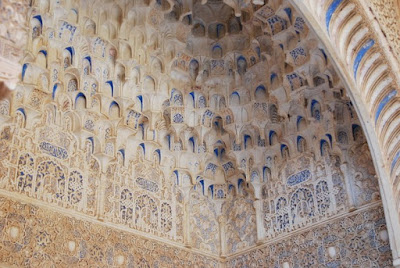
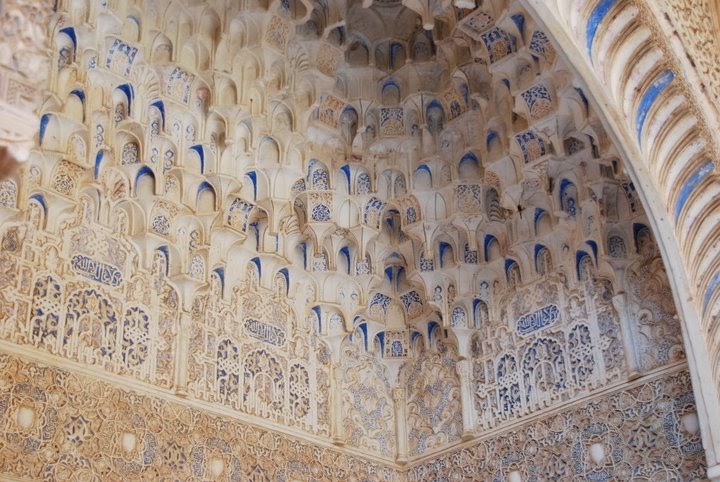
Some of the wall carvings at the Alhambra.  Note the Arabic poetry near the bottom.


Intricate ceiling at the Alhambra


More Alhambra detail


More Alhambra detail


In the gardens of the Alhambra


Some of the Alhambra fortress walls

Alhambra reflecting pool

The Alhambra at night as viewed from the city. 

Alhambra Gardens


Granada is also where Queen Isabella and King Ferdinand are buried.  The "Catholic Monarchs" led the recapture of Granada from the Moor's in 1492, creating a unified Spain.  Unfortunately, it also created an environment where Muslims and Jews were expelled to provide religous harmony.  Among other notable (and more positive) accomplisments, Isabella and Ferdinand commissioned Christopher Columbus' voyage to the New World.  The two monarchs are buried in the Royal Chapel along with their daughter, Juana la Loca (Joanna the Mad) and her husband, Felipe el Hermoso (Philip the Handsome).  Philip must have been quite handsome.  He died young and his wife, Juana, had his lead casket carried with her so that she could lift the lid and kiss him each night.  Her name appears to suit her well. 

The Cathedral as viewed from Alhambra

Stained glass in the Cathedral


Inside the Cathedral

Columbus requesting support from Queen Isabella

Many of the balconies in Spain had Santa's climbing up the railing.  This is the only balcony I saw that had the three Wise Men making their delivery. 


The drive from Granda to Cordoba went through a beautiful range of small mountains whose slopes were covered with olive trees.  In some places it seemed like there were olive trees as far as you could see, and we could see pretty far.  I had planned to write all about olive ranching, but fate intervened.  We stopped in the small town of Baena intending to visit the Museo del Olivar y el Aceite (Olive Oil Museum).  Recognizing that they would close for siesta from 2 - 4:00, we timed our visit to arrive precisely at 4:00.  Unfortunately, during the hoilday week they adjusted their hours to only be OPEN from 2 - 4:00 each day.  So your lesson on olives will have to wait until we visit Italy. 

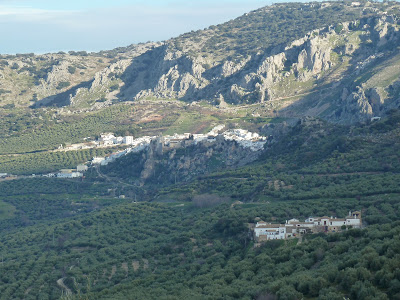
Note the olive groves in the background.  We saw groves like this for two hours of our drive. 

The town of Zuheros built into the side of the mountain.  We ate lunch at a the set of white buildings in the foreground. 


An abandoned fortress/cathedral that we saw on the drive to Cordoba

Cats are the same around the world...they can't resist a warm car hood in the sun.


Kate and Grant in front of an olive tree.  Lori picked one to eat, but it was super sour. 


Our last stop on the trip was Cordoba.  No we didn't see Ricardo Montalban advertising Chrysler cars.  But we did see the Mezquita, or Mosque.  Built between the 8th and 10th centuries, it's one of the earliest examples of Spanish Muslim architecture.  After the reconquest in the 1200's, it served as a Cathedral so as you tour it today you see a building with a blend of Muslim and Catholic religions.   You will note in the photo's that by this point in the trip, some members of our group had contracted a severe case of "audio-guide-itis".  Their brains were simply unable to absorb any more historical facts or listen to readings of one-thousand year-old Arabic poetry.  So they just walked around the Mesquita and enjoyed its beauty; something that was quite an easy thing to do. 

In the category of learning more about the Spanish culture, we noticed that on the evening of January 5th, there were many elaborate parades in Cordoba and the surrounding towns.  When we asked about their purpose, we learned that the Spanish large holiday celebration occurs on Epiphany, or January 6th.   The parades were for the Wise Men coming and giving gifts (actually they were throwing out candy).  The bakeries were selling King Cakes, which were circular similar in shape to a New Orleans King Cake, but they had some type of whipped cream filling.  Supposedly, there were also a few presents in the cake.  The next day, the town was empty as families stayed home and opened their presents. 


The Cathedral Choir within the Mesquita. 


The Mesquita includes over 850 columns topped by ornate capitals and arches.


The ceiling in one section of the Mesquita


Another section of ceiling. 


An example of the detail within the Mesquita. 


I'm sure that he was a famous Cardinal in Cordoba, but he looks rather like Yoda. 


The outside of the Mesquita (on the right).


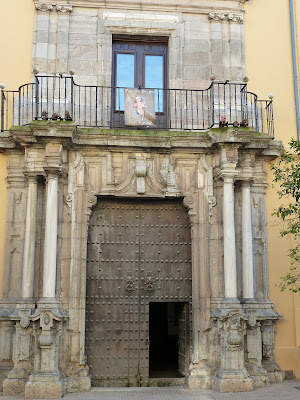
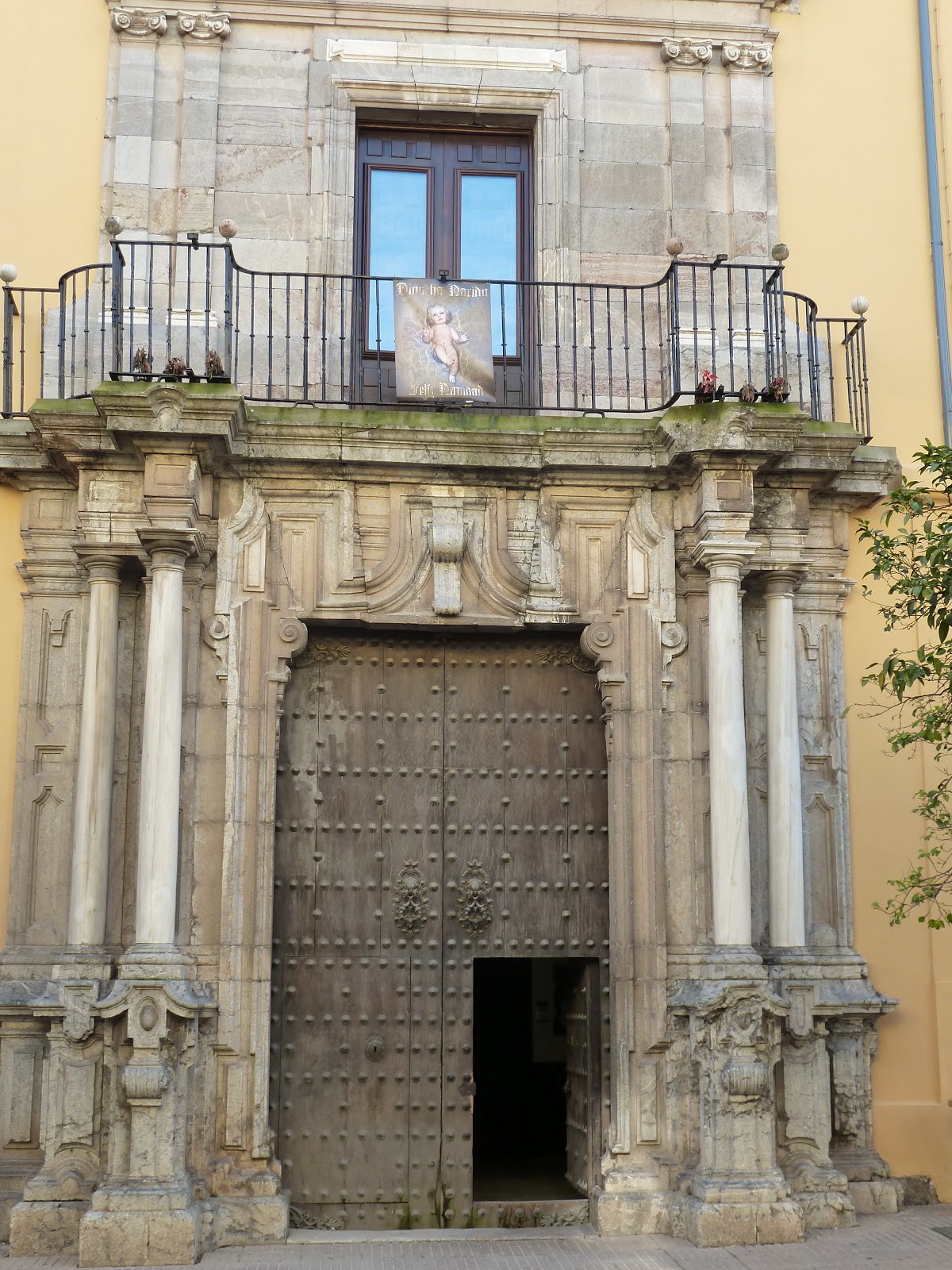
I love the practicality of this.  Install huge doors because they look nice, but cut a small door within the larger one for everyday use. 


In the Alcazar, Mosaics from the 2nd or 3rd century when the Romans ruled the Cordoba.

A single tree that grows both oranges and lemons. 

A frequent site on the trip.  We'd get lost and Lori would whip out the guidebook and save us. 


The only Jewish Synagogue in Andalusia to survive the inquisition in 1492 and one of only 3 in all of Spain. 


Carol enjoyed the local cuisine....oxtail stew.