At the last minute, we decided to take a short trip in June. Lori had to work, so it was Grant, Kate and myself. Our selection criteria for the vacation were: warm weather, scuba diving school and flights available (since we were planning this w/ one week lead time). The island of Rhodes, Greece matched those criteria plus it came with an added bonus -- our friends, the Sechlers, would be there for part of our stay. How could we pass it up?
When I mentioned our criteria of "flights available" you'll notice that I didn't save "flights available on major airlines". This was our first experience on a European discount airline, in this case Transavia.com. The airline actually turned out to be fine - clean planes, on-line check-in, etc. The only surprise was that they counted anything larger than a cell phone as carry-on luggage and you could only have one carry-on bag, So we had to pay to check our suitcases. It's amazing how quick you can load a plane when no one has any carry on luggage.
Our biggest challenge was getting to the plane. I tried the economy parking lot for the first time, which was described on the Schiphol website as "minutes away from the Departures Area". The actual transfer bus departure point was only "minutes away". Unfortunately, the parking lot was about 500 acres and very full, so to get from our parking spot in the back 40 to the transfer bus was a healthy walk. Plus we foolishly thought that the aiport wouldn't be busy at 5:00 am (we had a 6:30 am departure). It turned out to be packed as many other families were traveling that day as well. In the end we made it to the plane with 15 minutes to spare.
Back to Rhodes. It's an island of about 100,000 people in the Agean Sea. It's closer to Turkey (10 miles) that it is to Athens (250 miles). Historically it has been very agile in switching alliances to the strongest countries at the time, bouncing between Athens, Sparta, the Persians and Rome. In more modern times, Italy siezed control of Rhodes from the Turks in 1912. Then, as part of the Allied Peace Treaty, Rhodes was given to Greece in 1947.
The island was home to the Colossus of Rhodes, a 32 meter bronze statue of Helios, the Sun God. Built in 300 BC to commemorate a battle victory, it was one of the Seven Wonders of the Ancient World. Unfortunately, there won't be any pictures of it on the blog -- it was destroyed by an earthquake in 225 BC. St. Paul is said to have visited Rhodes. And for one final Rhodesian fact, per the Encyclopedia Britannica, the island was infested by snakes in ancient times and even today farmers still wear leather boots for protection agains the poisonous snakes. Funny how that wasn't mentioned in the tour books.
We had a great time on the island. The sun shone every day. Grant completed his scuba diving certification. Kate and I did five dives, including two wreck dives. The sunken boat was Dutch built, but the Dutch divemaster was quick to point out that was not why it sank (he never did say why it sank).
The dive shop closed on Sundays, so we had a day to sightsee in Old Rhodes Town. It is enclosed by massive walls and filled with winding streets and alleys. The Knights of St. John ruled the island for 200 years beginning in the early 1300's and turned this area into a fortress to protect ships from the Turks. Within the Old Town is the Palace of the Grand Masters. It was built in the 14th century, but severely damaged by a Turkish siege and then destroyed by an explosion (another reminder of the dangers of gunpowder storage) in the mid-1800s. The Italians completely rebuilt it during their control of the island. It was intended as a holiday home for Mussolini and King Emmanuel III.
Our return travel was a little challenging. Our departure date coincided with the protests scheduled in response to Greece's proposed economic austerity measures. There was no violence on Rhodes, but many employee groups, including the air traffic controllers, went on strike that day from 8 until noon and from 6 until 10 pm. So our scheduled 9:30 pm flight got pushed back to midnight.
At 11:00 pm, as we waited for our flight, it was suddenly removed from the schedule board. Not listed as delayed or cancelled. Just not listed at all. That was quite an unpleasant surprise. And believe it or not, there was no Transavia.com help desk to direct my inquiry -- it closes at 9:00 pm. After about 45 minutes, it re-appeared on the board with a departure time of 2:30 am. This delay must have been due to the airline because there was an announcement (in Dutch) followed by cheering. Then I started seeing a lot of people smiling and carrying sandwiches. I went to the sandwich counter and asked the lady "Why is everyone getting a sandwich?" She replied "Yes" and thrust three sandwiches into my hands. Once again we learned that you get what you pay for. The bread was rock hard and there was one thin slice of meat on the sandwich.
We finally departed at the newly scheduled time and arrived in Holland at 5:00 in the morning -- ouch. It was another "few minutes" back to the parking lot, etc. We arrived home at 6:30 am, just in time to see Lori off to work and then go to bed.
 |
| The city of Lindos going down to the coast. With the white washed buildings and crystal clear water is was just what you expected from Greece. |
 |
| The Acropolis at Lindos |
When I mentioned our criteria of "flights available" you'll notice that I didn't save "flights available on major airlines". This was our first experience on a European discount airline, in this case Transavia.com. The airline actually turned out to be fine - clean planes, on-line check-in, etc. The only surprise was that they counted anything larger than a cell phone as carry-on luggage and you could only have one carry-on bag, So we had to pay to check our suitcases. It's amazing how quick you can load a plane when no one has any carry on luggage.
Our biggest challenge was getting to the plane. I tried the economy parking lot for the first time, which was described on the Schiphol website as "minutes away from the Departures Area". The actual transfer bus departure point was only "minutes away". Unfortunately, the parking lot was about 500 acres and very full, so to get from our parking spot in the back 40 to the transfer bus was a healthy walk. Plus we foolishly thought that the aiport wouldn't be busy at 5:00 am (we had a 6:30 am departure). It turned out to be packed as many other families were traveling that day as well. In the end we made it to the plane with 15 minutes to spare.
Back to Rhodes. It's an island of about 100,000 people in the Agean Sea. It's closer to Turkey (10 miles) that it is to Athens (250 miles). Historically it has been very agile in switching alliances to the strongest countries at the time, bouncing between Athens, Sparta, the Persians and Rome. In more modern times, Italy siezed control of Rhodes from the Turks in 1912. Then, as part of the Allied Peace Treaty, Rhodes was given to Greece in 1947.
 |
| A view of the inland part of Rhodes. |
 |
| Kate resting in Old Rhodes Town |
 |
| As you can see, a few other people were seeking the sun. Luckily, we didn't beach here. We had to walk through here to get to our Scuba Diving boat. |
The island was home to the Colossus of Rhodes, a 32 meter bronze statue of Helios, the Sun God. Built in 300 BC to commemorate a battle victory, it was one of the Seven Wonders of the Ancient World. Unfortunately, there won't be any pictures of it on the blog -- it was destroyed by an earthquake in 225 BC. St. Paul is said to have visited Rhodes. And for one final Rhodesian fact, per the Encyclopedia Britannica, the island was infested by snakes in ancient times and even today farmers still wear leather boots for protection agains the poisonous snakes. Funny how that wasn't mentioned in the tour books.
 |
| One of our favorite restaurants, a typical Greek Taverna. |
 |
| Rather than try to expain the menu to non-Greek speaking Americans, the waiter simply took all six of us to the kitchen and showed us what was available that evening. |
 |
| Eating with Caroline, Carol & Mark Sechler |
 |
| This seafood restaurant dried the octopus right by patio. |
We had a great time on the island. The sun shone every day. Grant completed his scuba diving certification. Kate and I did five dives, including two wreck dives. The sunken boat was Dutch built, but the Dutch divemaster was quick to point out that was not why it sank (he never did say why it sank).
 |
| Grant with his dive instructor, Jerry (who happened to be Dutch). |
 |
| The dive school caters to people from all over Europe |
The dive shop closed on Sundays, so we had a day to sightsee in Old Rhodes Town. It is enclosed by massive walls and filled with winding streets and alleys. The Knights of St. John ruled the island for 200 years beginning in the early 1300's and turned this area into a fortress to protect ships from the Turks. Within the Old Town is the Palace of the Grand Masters. It was built in the 14th century, but severely damaged by a Turkish siege and then destroyed by an explosion (another reminder of the dangers of gunpowder storage) in the mid-1800s. The Italians completely rebuilt it during their control of the island. It was intended as a holiday home for Mussolini and King Emmanuel III.
 |
| Cannon balls in the dry moat area. |
 |
| Kate and Grant at one of the gates to the Old City. |
 |
| All the streets in the Old City were narrow and winding. |
 |
| These vines make it tough to see the street sign. |
 |
| With Lori's absence, Kate stepped up to chief tour guide. |
 |
| The interior courtyard of the Palace of the Grand Masters |
 |
| Entryway to the Grand Palace |
 |
| As part of the Italians' renovations, they moved dozens of 2000 year old floor mosaics from the island of Kos to Rhodes. |
 |
| Another floor mosaic. |
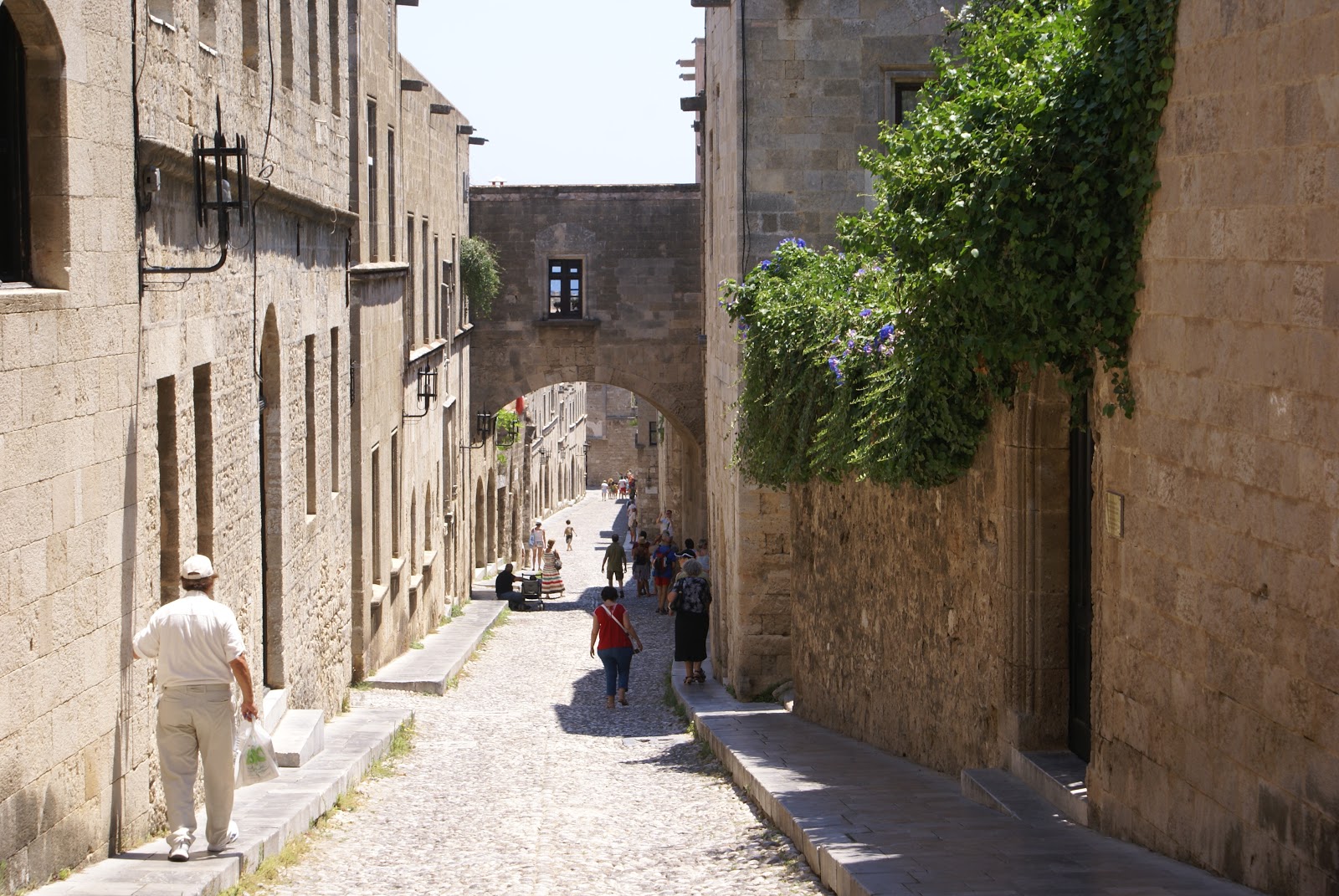 |
Avenue of the Knights leading from the Grand Palace. The street was divided into seven "tongues," according to the homeland of the knights who lived there. The Grand Master lived in the palace at the top of the hill. |
 |
| This girl's begging strategy included a puppy and an accordian. It didn't work very well; her basket is empty. |
 |
| Kate and Grant in one of the Old Town squares |
 |
| We had lunch on the second floor patio of this restaurant. The guy behind Kate is working with his "spotters" in the square below, trying to entice people to come to his restaurant. |
 The local gelato shop made their flavors look like animals. | ||
|

 |
| One of the Knights of St. John with some tourists |
Our return travel was a little challenging. Our departure date coincided with the protests scheduled in response to Greece's proposed economic austerity measures. There was no violence on Rhodes, but many employee groups, including the air traffic controllers, went on strike that day from 8 until noon and from 6 until 10 pm. So our scheduled 9:30 pm flight got pushed back to midnight.
At 11:00 pm, as we waited for our flight, it was suddenly removed from the schedule board. Not listed as delayed or cancelled. Just not listed at all. That was quite an unpleasant surprise. And believe it or not, there was no Transavia.com help desk to direct my inquiry -- it closes at 9:00 pm. After about 45 minutes, it re-appeared on the board with a departure time of 2:30 am. This delay must have been due to the airline because there was an announcement (in Dutch) followed by cheering. Then I started seeing a lot of people smiling and carrying sandwiches. I went to the sandwich counter and asked the lady "Why is everyone getting a sandwich?" She replied "Yes" and thrust three sandwiches into my hands. Once again we learned that you get what you pay for. The bread was rock hard and there was one thin slice of meat on the sandwich.
We finally departed at the newly scheduled time and arrived in Holland at 5:00 in the morning -- ouch. It was another "few minutes" back to the parking lot, etc. We arrived home at 6:30 am, just in time to see Lori off to work and then go to bed.
 |
| This is what an airport check-in area looks like at 9:00 pm when the air traffic controllers are on strike until 10:00 pm. It was totally empty. By 10:30, things were hopping. |
 |
| The complimentary sandwiches. Yum! |
 |
| Our hotel had entertainment every night. One night it was belly dancing. The only people in the audience were the belly dancer's two granddaughters. On this night was the Fire Show. The guy swallowed fire, rubbed it on his arms and chest, put it out with his hands, etc. About 15 minutes into the show, the fire alarms all went off. I guess the hotel forgot about that aspect of the Fire Show. |
 |
| We discovered many cats during our walk through the old city of Rhodes. If you look closely at this photo you can see the cat jumping from the electrical wires to the roof. |
 |
| This guy was sleeping on a ledge when we walked by. |
 |
| When we walked by 10 minutes later he had changed ledges. |
 |
| Do you think he stays on when it's going? |