Thursday, March 31, 2011

Petra

 
Views as we hiked the hills in Petra.
Jordan is a wonderful country with many historical sites to see, but if you were allowed only one stop in the country you would choose Petra.  This ancient city with ornate facades carved into the side of sandstone cliffs is incredible.

The city served as a cross-roads of trading routes between the Orient, Europe and the Mediterranean.  It's most prosperous years were between 100 BC and 100 AD where the population approached 30,000 people.  However, trade routes changed, the Romans took over from the Nabateans and Petra began to decline.  It was deserted by the 700's.  An Egyptian sultan passed through Petra in 1276 on the way to Karak -- he is believed to be the last person other than local bedouins to know about or see Petra for over 500 years. 

After being lost for centuries, Petra was discovered by many Westerners (including the author) in the 1989 film, Indiana Jones and the Last Crusade, where the exterior shots for the final scenes were filmed.  Others may know it from Agatha Christie's Appointment with Death.  However, neither of these would have been possible without the first "re-discovery", which was in 1812 by a Swiss explorer who disguised himself as an Arab to gain access to the Middle East.  When you travel to Petra it's easy to see how something this large could be hidden for so long.  There is essentially one way in and out, through a mile-long trail in a narrow gorge -- The Siq.

On the night of our arrival, we viewed "Petra by Night".  We  (and about 500 other people) walked down the candle-lit Siq to the base of the Treasury.  Although it was plenty touristy (we all sat on the ground while they served tea, local musicians played unique instruments and the host closed with a speech that included a call for World Peace) it was neat to walk in the canyon and see the stars overhead.  As you can imagine there were not a lot of lights nearby so the sky was full of stars. 

Petra by Night.  Not quite as dark as Mammouth Cave, but close. 

The Siq.  This picture was taken late in the day....as evidenced by the lack of tourists.  The mile-long walk gently slopes, which as the guide book says, "...is barely noticeable on the way down, but is murder on tired thighs on the way back up".  All told it is the elevation change is equivalent to a 45 story sky scraper.  We walked the trail three times.


No these are not the chariot racers from Jerash.  For those unable to make the walk out the Siq, you can ride in comfort in these carts.  If the passengers look to be holding on for dear life, it's probably true.  The drivers go fast so they can pick up their next fare and the road is often ancient, Roman block.  No suspension on the carts either.  Walking wasn't that bad after all.   

The Treasury.  By being carved deep into the rock face, it has been well-protected for over 2,000 years.  This facade was used in the Indiana Jones film. 

  
Grant on what we thought was the Altar at the High Place of Sacrifice.  After this picture, a local informed us that this was acutally a place of preparation for the sacrifice.  I thought that this was a much better picture than the real altar.  It is not known if the Nabatean's practiced human sacrifice.   

Lori bargaining with the local jewelry merchants. 


Petra hill caves.  The Nabateans were bedouins and lived in tents.  The carved caves were tombs, temples, etc. 
  
One of the views on our hike


Time for a rest after a long climb to the High Sacrifice Point

A familiar theme on our holidays....Lori checking with the book on where to go next.
 
The inside of one of the tombs. 
 

Lori and Grant at the beginning of the trail to the Monastery.  Only 800 more steps to go. 

The Monastery.  It was well worth the climb.


We rode donkeys for part of our journey back to the Siq. Unfortunately, it wasn't the uphill part. 


The 5th century churches in Petra have beautiful floor mosaics.  Even better than that, you could view them while enjoying the shade of the canopies constructed to protect the mosaics from the sun.

Petra City Center


The curved portion in the center is an amphitheater carved out of rock.  It seated about 3,000 people. 


Yee Haw!  The entrance price included one free horse ride up the last part of the trail to town.  Lori's guide let her gallop; if you look closely you can see that she's not afraid to whip her steed with the rope. 


Others in the party traveled at a more leisurely pace.


Monday, March 28, 2011

Spring is Here


We have had beautiful weather the past two weeks.  All of my tulips bulbs are up and I've even got some blooms. 


Thursday, March 24, 2011

Jordan - Dead Sea Area

For February break we spent a week in Jordan.  The political unrest in Tunisia, then Egypt, then lots more places in the Middle East certainly kept our attention prior to the trip.  There were reports of some protests in Jordan, but they were mainly in Amman (not our primary destination) and seemed to be fairly peaceful.  The US State Department hadn't issued any travel warnings, so off we went. 

As it turned out, we didn't have any disruptions nor did we see any protests.  The Jordanians were very friendly, very willing to give you their views on Egypt (always supportive of the revolution), but not so forthcoming on the future of Jordan.   That may be because they are not really sure what the future should look like, rather than being reluctant to speak openly.  Although Jordan's monarchy is progressive, the country faces similar dilemnas as other Middle Eastern countries -- 70% of the population is under 30 years old and unemployment is 20%+.  Lots of young people without jobs does not bode well for long term stability.  I'm not sure what the future should look like either, but I do wish the Jordanian people the best of luck and thank them for delaying any revolution until we completed our journey. 

We spent the first two days in the area near the Dead Sea.  Leaving the airport in Amman you drive for about 20 minutes on partially finished highways through some unremarkable towns.  Then you turn off the highway towards the Dead Sea and you begin to descend.  And descend.  And descend.  At 1200 ft below sea level this is the lowest point on earth.  At this elevation, the summer weather would have to be horribly warm and muggy; but February weather was very pleasant.   The Dead Sea has no outlet; it loses water only by evaportation which results in a salt content of 30% (vs normal sea water of 3-4%).  We read that the high salt content makes you incredibly bouyant.   Anyone can float and it's impossible to walk in the water.  Unfortunately, the pleasant February weather included strong winds so the beach had the red flags posted and we couldn't go in the water. 


This was as close as we got to the Dead Sea


Flowers in the lobby of our hotel


Even in Arabic you know what they're drinking


The area around the Dead Sea is rich in history.  Jerash was a thriving Roman city of 25,000 people in the 2nd and 3rd centuries.  It was essentially destroyed by an earthquake in 749 and not "rediscovered" until the 1800's.  Now the huge site offers a very well preserved Roman city with a hippodrome that seated 15,000 people, a huge theater, temples, collonaded streets and several churches.

Gate to the City of Jerash
 
No skyboxes at this hippodrome.  Everyone sits on hard concrete. 

Windy day.  Now you can see why we didn't swim in the Dead Sea.


My fraternity greek lessons weren't enough to let me read this. 


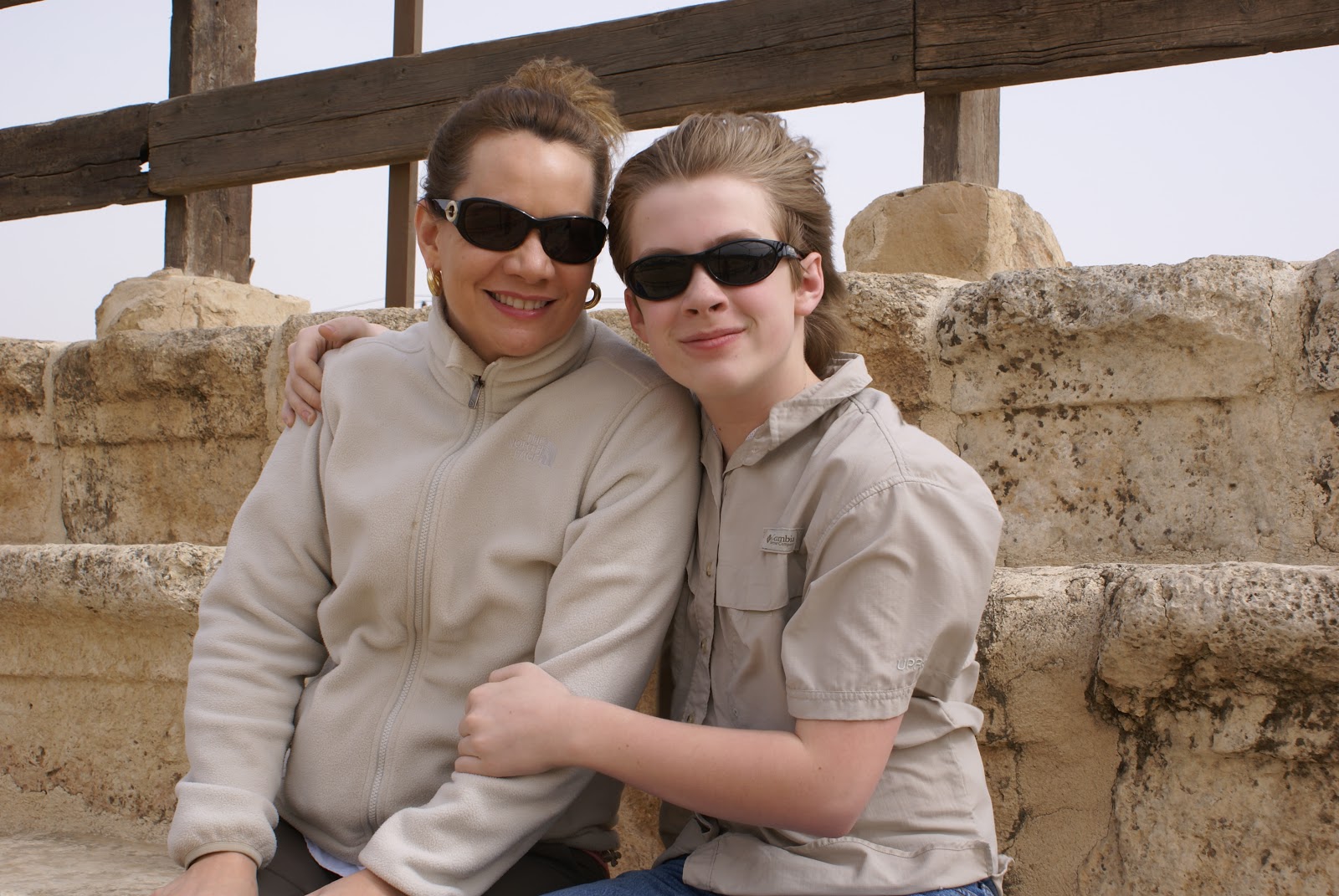
This is a picture of Lori taking a picture of us while we sit in the top row of the theater seats.  I hope they didn't charge much for these seats.   

Notice the wet stones.  Jordan receives 8 inches of rain a year.  We were there for about 10% of that. 


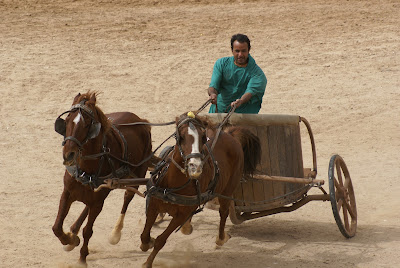
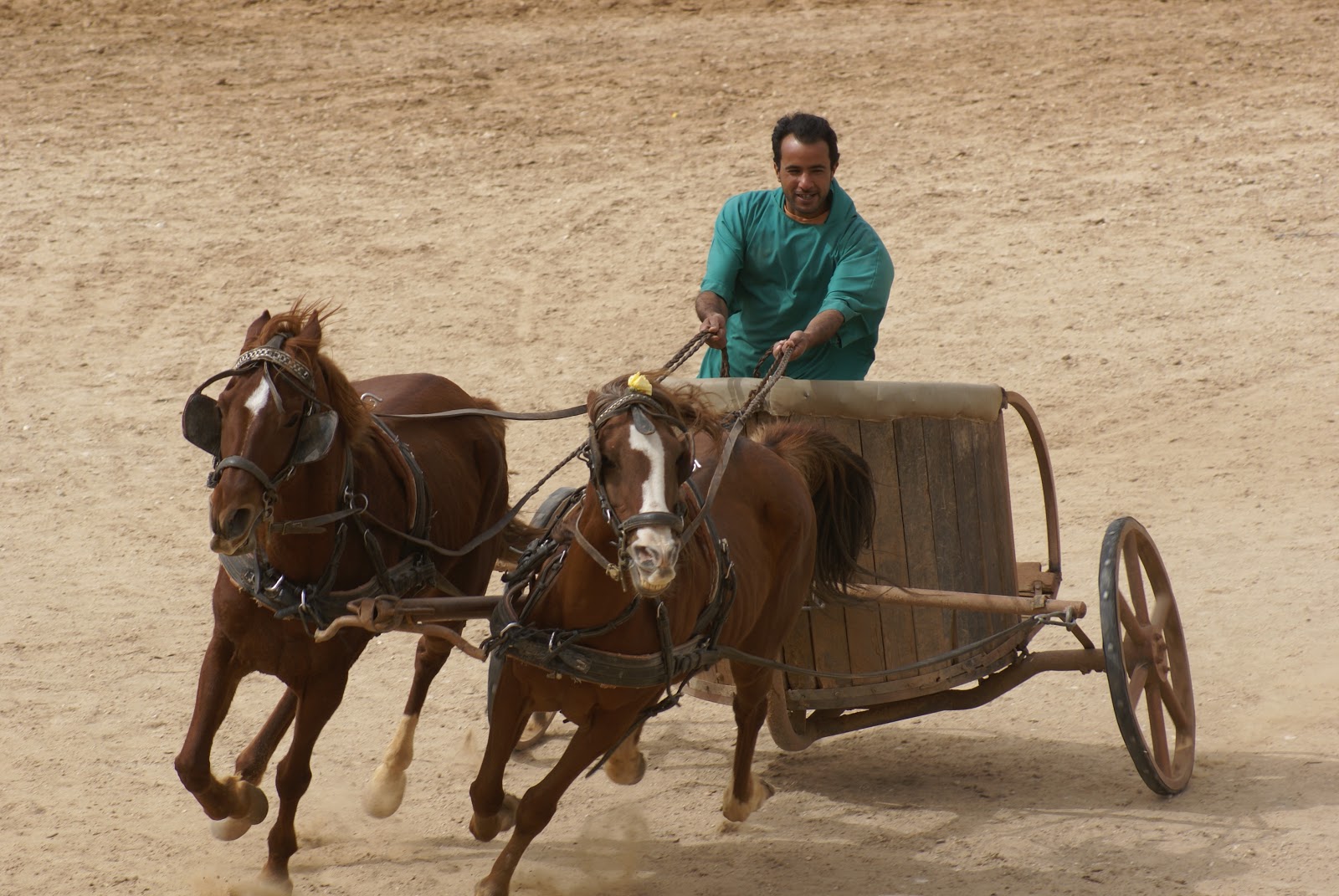
They stage chariot races and mock gladiator battles in the hippodrome.  For those old enough to remember the movie Ben Hur, you'll recall the armor plated chariots used by Charlton Heston.  Evidently, those are not historically authentic (what a surprise).  Per the guidebook, the actual chariots were "less visually impressive, but much faster".  As you can see in the pictures, they are essentially flimsly bamboo/wicker carts that are not very substantial at all.  But they are fast!  Those guys were really going. 

Just like at Quad City Downs


Would you feel safe in this?


We also visited Bethany Beyond the Jordan, which was where John the Baptist lived and is also the most probable location where he baptized Jesus Christ.  The site was closed with the outbreak of war in 1948 but was re-opened following the1994 peace treaty between Jordan and Isreal (and after the area was swept for landmines.  Don't worry, we stayed on the path).   Our experience here proved that Jordan still has some work to do on tourism.  To visit the site, you park your car, buy tickets and then travel by shuttle bus to the baptism site.  We were the first (and only) people there that morning.  A very friendly host helped us buy our tickets then explained that the bus (which was parked right there) would not leave for another 30 minutes.  Having no other choice, we waited.  After about 3-4 minutes, the bus fired up and away it went.  Without us.   It returned in about 20 minutes, we boarded and away we went......despite the fact that the 4th and 5th visitors of the day had arrived, were buying their tickets and were looking rather startled that the bus was leaving them.  So after much hand-waving and shouting, the bus turned around and picked them up.  Maybe things run smoother when it is more crowded. 

No, this isn't where Jesus was baptized.  This is a pool built nearby for group baptisms. 


This is THE site.  The pilars are from churches that were built later.  Jesus descended the steps to enter the water.  In case you're wondering about the lack of water, the Baptism site was on a backwater area of the Jordan.  Now that river levels are down, it's dry. 


The infamous bus. 


There are many churches built near the baptism site.  The painted ceiling of this one shows that some people had a hard time staying awake in church back then also. 
 After visiting the Baptism Site, we walked to the River Jordan.  Life has been hard on the Jordan.  Several diversion projects have significantly reduced the flow so that it is less than 20' wide.  Certainly not the grand river that I had imagined.  But it's historical significance remains and it was still somewhat humbling to walk down the platform steps and dip my hand in the water.  Interestingly enough, both of our children were baptized with water from the River Jordan.   The minister who baptized Kate had travelled to the Holy Land and brought back water from the river for baptisms.  When Grant was baptized, the grandparents of the child that was baptized first that day had also travelled to the Holy Land and brought back water.  Since the Jordan River water was already in the baptismal font, Grant got the extra holiness for free.

  
Grant and Lori by the Jordan River.  It's about as big as Canoe Creek. 


Another view of the Jordan.

Jordanian army stationed at the Jordan River because......

.....Israel is over on the other bank.


  Our final stop in this area was Mount Nebo, where Moses saw the Promised Land after leading the Israelites through the wilderness for 40 years.  It's a fantastic view that provides a view of the Dead Sea, Jordan River, Jericho and the hills of Israel.


On the drive up to Mt. Nebo.  Note the bedouin tents in the desert. 


This is the view of the Promised Land from Mt Nebo.  Perhaps it wasn't so hazy when Moses was looking. 


In case you didn't recognize the sites in my picture from Mt. Nebo


Wednesday, March 23, 2011

Happy Mardi Gras

Grant's school celebrated international day on the Friday before Mardi Gras.  People were supposed to bring food native to their country, so he and I baked a King Cake.  Actually I baked and he frosted.  I wouldn't call my first attempt at yeast breads an overwhelming success; it's a good thing that middle schoolers aren't too picky when it comes to sweets. 


It wasn't pretty but it tasted good.

While we were setting up the lunch, I noticed that 2-3 Norwegian women brought waffles.  I hadn't realized that waffles were a Norwegian staple, but a quick visit to the internet revealed that "Waffles are a Norwegian tradition.  Not a week goes by in a Norwegian home without a waffle being eaten."  Sounds like my kind of country. 

Kate's Mardi Gras was a little more exciting -- she went to New Orleans to celebrate the real thing!  Now that Mardi Gras is over, we're into Lent.   Since many people "give up" something, i.e. candy, Facebook, etc., during these 40 days, some of you may have wondered if I've given up blogging for Lent.  Not to worry, the Jordan trip will be posted soon. 


Sunday, March 6, 2011

Escher Museum

The sun arrived in Holland today so we (along with the other 16 million other inhabitants) found something to do outside.  Even though the temperatures were only in the 40's, it was too nice of a day to stay inside.  We hopped on our bikes and rode down to Den Haag to visit the Escher Museum. 


Grant has picked up the Dutch tradition of riding with no hands.  It also appears that he's starting his own tradition of riding with his eyes shut. 

Lori looking Dutch -- wearing leggings and boots while cycling. 

M.C. Escher (1898 - 1972) was a Dutch graphic artist who specialized in wood cuts and lithographs of impossible structures...stairways that go both up and down, waterfalls that flow upwards and buildings that could never be built.   Although he was not a mathematician, his work is quite mathmatical, with repeating patterns, symmetry and tesselations.  For those of you who, like me, didn't know what that word meant...here it is:  "Tessellations mean designs featuring animals, birds, etc, which can fill the page, without gaps or over-lapping, to form a pattern that completely fills a space. It's the simplest kind of jigsaw puzzle: all the pieces look alike!"  So for two engineers and a 13 year old who knows everything, it was a great museum. 

The other interesting thing was that the museum is housed in the former Winter Palace of Queen Emma (1858 - 1934).  Three successive Queen's worked here as well....Queens Wilhelmina, Juliana and Beatrix....until 1991.


The Escher Mueum in the former Winter Palace


Note the symmetry and the patterns. 

Escher's Waterfall.  Follow the water around the circuit; it defies gravity.  


With the advent of sunshine and (slightly) warmer weather, there are many wild crocuses.  It's the Dutch equivalent to Texas Wildflowers. 


After the museum we rode to lunch.  This is a bike parking lot.  For 20 cents you park your bike in a secure area.  What a great deal!  Only in Holland. 


Our route home took us by Queen Beatrix's current palace, Huis ten Bosch Palace.