|
| Two cheetah brothers |
Prior to Easter break Lori had a business trip to South Africa, so after her meetings Grant & I flew down to meet her and all go on safari. He and I were excited because the Paris - Johannesburg leg of this trip was our first on the Airbus 380 -- the double decker jet that holds 500 people. It definitely dwarfed the other planes at the airport. The other nice thing about the trip was that despite a 10 hour flight, there was no time zone change so we didn't have to fight jet lag.
 |
| Not the best picture (taken through the airport glass) but you get the idea. Multiple loading ramps, double decker, four engines -- really big plane. |
We met Lori in Durban, where we continued our theme of seeing big things. This time it was a visit to the Gateway Theater of Shopping, which is a fancy name for the Gateway Mall. It bills itself as the largest mall in the Southern Hemisphere. I'm no expert, but it is certainly in the top 5. We didn't do any actual shopping (or rock climbing or go karting or watch an IMAX or any of the other entertainment options ) but we did manage for find a Cinnabon Store.
 |
| Gateway Theater of Shopping |
The following day we set off on our safari adventure. Before you start thinking about how brave we were to rough it in the rugged South African countryside, let me describe our lodge. This was not a scouting trip with campfire-cooked food and sleeping in pup tents on the hard ground. The lodges had around 15 cabins, all with hot, running water, king-sized beds, maid service and air-conditioners. The food was prepared by professional chefs with lots of fresh, local ingredients. We had cappuccino in the morning and wine at dinner. Our intent was to see animals, not live like them.
 |
| Our "cabin" at Phina. The woods were dense enough so that you couldn't see the other cabins. Despite that, we still shut the curtains at night. |
 |
| Not a great picture, but this was the view from the dining area. We saw an elephant, warthogs and impala walk across the grass at various times. |
So while we may have lived like kings, there was still some element of danger. The lodges were unfenced, so you weren't allowed to walk on your own after dark. Rather, you were guided by a ranger armed with a......flashlight. I'm not sure how that made it safer, but we readily complied with the rule. The day before we arrived one of the elephants had been hanging out at the swimming pool so intrusions were not unheard of.
The best times to see the animals are early in the morning and late in the day. So we started the day early -- waking up at 5:00 am, having a quick coffee and biscuit then getting in the safari jeeps for a 2-3 hour drive through the reserve. The roads were slightly better than the lanes at the farm, but there were still plenty of bumps. Many times we went off road in search of the animals; that was when you really had to hang on.
 |
| The early wake up call got the best of some members of our crew. |
Two rangers led us on the drives. One was the driver; he was the leader of the two. The second person was the tracker. He would sit in a special seat off the front bumper so that he could see the tracks in the road or the fresh poop in the road; he would then relay this information to the driver who would decide which direction to go. But of course the most useful tracking technique involved a walkie-talkie so all the drivers could communicate what they had found and where. Sometimes it didn't seem like the tracker really did anything. But then, just when you'd question his value, he'd spot some 2 inch long chameleon in the bush as we drove by at 20 mph or a leopard hiding in the grass at night.
 |
Our jeep with Sam, the driver, and Prince, the tracker (in action). Often times Prince would get off, take a machete for protection and walk around without us to "find the tracks" while we drove off in hunt of big game. This was also a convenient time for him to smoke. Then 45 minutes later we would go look for him -- and he'd jump out of the bushes and scare all of us out of our wits.
|
 |
| The tracker found this leopard our first night. |
Being on a reserve, most of the animals were used to the jeeps so if we did find them, they didn't run away. However, that didn't mean they were easy to find. For example, one day we wanted to see elephants. We looked for 2 hours but never saw a single elephant. Seems like elephants would be kind of hard to miss. We even turned off the jeep and listened for them, but the elephants already knew that trick and stayed real quiet.
 |
| We did manage to find this guy. Or rather he found us. Here he was flapping his ears and stomping to try and scare us away. We took the hint gave him some space. |
At the end of the drive, we'd stop at some safe location and the ranger would serve coffee, tea, hot chocolate and some breakfast snacks. After all the bouncing around in a jeep, that was also the time we'd find the bush toilet. Then we'd head back to the lodge for a real breakfast -- omelettes, poached eggs, pancakes, fruit, etc. The middle of the day was open -- plenty of time for napping, swimming, more napping and lunch at 1:00 if you were hungry.
 |
| Sam preparing our morning snack in the bush. |
 |
| Hot chocolate on a cool morning |
Then it was back together at 3:30 for some (more) snacks before setting off on the second game drive. The routine was the same as the morning -- two hours of animal viewing, a stop for drinks and a snack, then a drive back to the lodge. The return drive was in the dark. Being in the middle of nowhere the stars were fantastic. It was clear enough to see the Milky Way and satellites going across the sky. We also saw some owls. Very nice.
Back to the lodge for dinner at 7:30 then off to bed (guided by the trusty ranger) to prepare for the same routine the next day. It makes for a very relaxing holiday -- you don't need to do anything, you don't make any decisions and the food is great. Plus no internet or cell phones.
 |
| The view from a high spot at Phinda. |
 |
| Some of the "roads" we drove on. |
We spent our first three days at Phinda Game Reserve, a private reserve of 45,000 acres located in the south eastern part of the country. Interesting Fact: Phinda is partially owned by two grandsons of J Paul Getty. Their ownership includes the reserve, the lodges and 35 other lodges in Africa that they market via the brand &Beyond. Their company promotes tourism that invests in the local people by providing training, jobs and infrastructure for the community. I'd like to say this sustainability focus was the reason we chose &Beyond, but in reality our decision was driven by their great food and luxury lodging. The Gettys have a home on the reserve, but they didn't invite us over to visit.
 |
| This was our plane from Phinda to Ngala. Instead of seating 500 people it had seats for 4 passengers and 2 pilots. The jeep driver had to drive down the runway to clear off the impala so we could take off. |
 |
| No bathroom on the airplane, so we all used the bush toilets beforehand. Here Lori had to wait her turn and let the warthogs clear out. |
The next two days were spent at Ngala Lodge, another &Beyond reserve and lodge. Ngala borders on Kruger National Park. Twenty years ago, they tore down the fences so now the animals wander throughout the parks. Here we had our first experience of rain on a safari, which really causes the whole thing to unravel. Open top jeeps & off-roading don't work well in the rain. Plus most of the animals are smart enough to get out of the rain and hide in the bush, so you end up driving around in a jeep, getting wet and cold, and not seeing any animals except impala. Plus you don't stop for drinks and snacks at the end. Many people (including my wife and son) skipped the game drive when it rained. They chose to sit around the warm fire at the lodge and drink hot chocolate and read a book. A very wise choice indeed.
 |
| A herd of impala. Or "lion food" as our guide called them. |
When you tell people that you've been on safari, a common question is "Did you see the Big 5". This term originates from safari game hunters and refers to the five toughest African animals to shoot -- elephant, lion, leopard, cape buffalo and rhino. Of these five the buffalo is considered the most dangerous. Supposedly, when they are wounded by hunters they are known to circle back around and attack the hunting party from behind. Seems like after the first time, the hunters would figure that trick out.
Interesting Fact: Elephants eat at least 14 hours per day. They spend the other 10 hours hiding from safari jeeps. Another Interesting Fact: Phinda Reserve has 4 prides of lions, but they will be moving some out in the near future to reduce it to three. In the words of our guide "the lions eat everything".
 |
| This is what happens when we let Grant take the pictures. |
 |
| After some parental coaching, Grant did a better job with this photo. Note my Tilley Hat. Recommended by my brother, Tom, and fully tested on our previous safari in 2007 these hats are great. They float, they tie on, they repel water, Tilley will replace them for free, they have a storage compartment.....and they look great. Most hats come in 5 or 6 sizes. Tilley offers 13 different sizes. These hats are so special they even come with an owners manual. |
 |
| We weren't at the Great Migration, but there were lots of wildebeests. |
 |
| Lori got a nice shot of this warthog. While they look ferocious from the front, when they run away they put their tails straight in the air and look exactly like Pumba in the Lion King. |
 |
| Look for the large bugs in the center of the photo. They are called dung beetles and so now you know what the two piles really are. Rhino poop. The family in our jeep that day was especially interested in these guys and must have snapped off 30 photos of them. |
 |
| I'd like to say this is an action shot of elephants stampeding into the water as the lions chased them down. Actually it's a evening picture of 15 or so elephants coming to the pond for a drink. It's blurry due to the low light and long shutter time. |
 |
| We found this lion and watched him for 5-10 minutes. I was starting to get a little bored when the driver pulled the jeep around the corner and we found...... |
 |
| ........more members of the pride. Like most cats, these lions didn't do much of anything except sit there. |
 |
| This mother was trying to give her mostly grown child a bath. The child just reached up with her giant paw and said "no". It didn't deter the mother at all. |
 |
| The king of the jungle was keeping cool under a tree. |
 |
| A family of black rhinos. |
 |
| Notice the bird cleaning out the right ear (as you look at it) of the front rhino. Wonder how that feels? Wonder if it's loud? |
 |
| White Rhino. As you can see, both the white and black rhino are grey. You (or more likely the ranger) can tell the difference by the shape of their mouth. |
 |
| These cheetah cubs are about 4 months old. |
 |
| Here they're following their mom. |
 |
| We were hoping they would run into some impala, so we followed then for about 1/2 an hour. But all they were doing was looking for a spot to sleep for the night. They found this spot and went to sleep and we went looking for giraffes. |
 |
| The feared cape buffalo. He does look pretty mean. |
 |
| Jackal |
 |
| You'd think we were being treated to a blood curdling roar. But no, he was only yawning. Remember he's a cat. |
 |
| No matter the size, cats really have no shame. |
 |
| Two brothers playing |
 |
| The reason the two brothers were so sleepy was that they had killed this buffalo the day before. They eat it from the inside out; this guy had his entire head in the abdomen and was munching away. In a couple of days the hyenas would move in and finish the carcass including the bones. |
 |
| Hyena cub |
 |
| We found a group of hyenas that had made their den out of an old termite mound. There were about 20 of them around the den that evening. Here two young ones nurse. |
 |
| This was as much as we saw of the hippos. They only came out of the water at night. |
 |
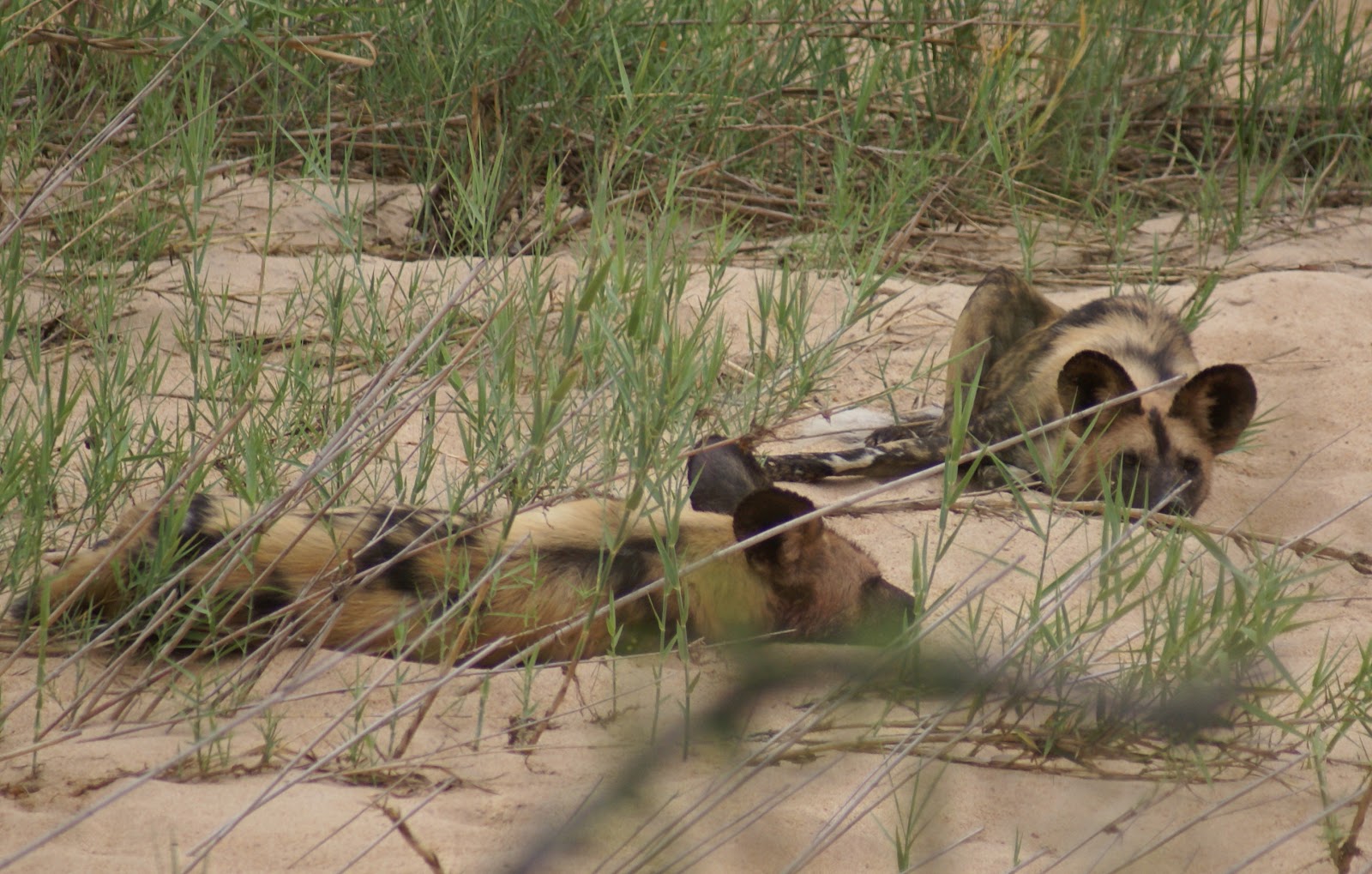
| African Wild Dogs have been hunted to near extinction. Only 5000 or so remain. We found a pack of 10 in a dry river bed. As you can see, the term Wild Dog may be more of a marketing gimmick. They look about as wild as our very un-wild dog, Graber. Lots of sleeping and yawning. |
 |
| This is the bush that we drove through to see the wild dogs. The ranger was not afraid to run over small trees. |